
Adsorption is a method of separation of gases or liquids by absorption of particles of an adsorbed substance on the surface of the adsorbent, in simple words it is a kind of sieve which retains some particles while others pass on, this happens due to the difference in kinetic diameter of the molecules. In the case of air separation we have two main gases which can be obtained by this method: oxygen or nitrogen (in some cases even argon).
In the field of air separation systems working according to the adsorption principle can be called differently:
- PSA (Pressure swing adsorption);
- VPSA (Vacuum Pressure Swing Absorption).
In oxygen generators synthetic zeolites are used as adsorbents; for nitrogen generators synthetic carbon molecular sieves (CMS) are used.
With the help of adsorption generators the following technical gases can be obtained:
- Gaseous oxygen - concentrations of 90-95 and 99*%;
- Nitrogen gas - concentration of 90-99,9995%;
Standard configuration of the adsorption unit:
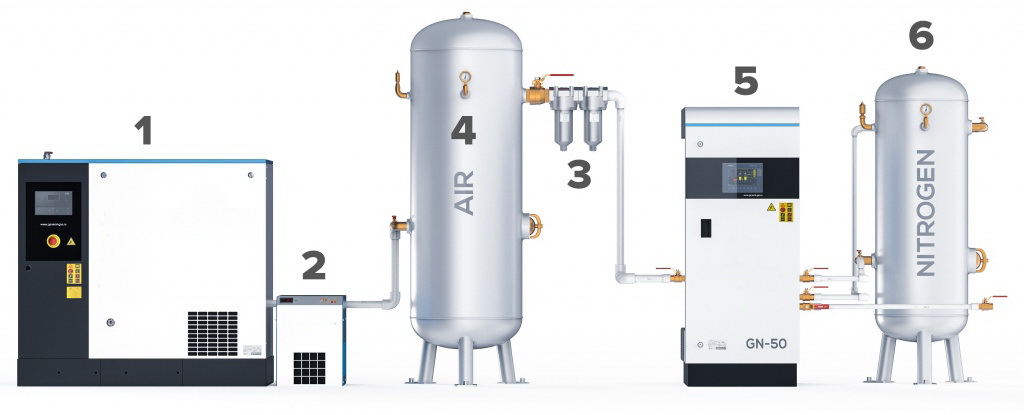
- Compressor - serves for air compression, usually an oil-filled or oil-free screw compressor is used;
- Compressed air dryer - serves to remove moisture from compressed air to the dew point of +38 degrees Fahrenheit;
- Filter system - serves to remove micro-particles of oil, dust and other impurities from compressed air;
- Compressed air receiver - serves as a kind of a compressed air "buffer" to equalize pressure at the inlet to the adsorption columns;
- Adsorption generator - serves to separate prepared compressed air into the main components nitrogen and oxygen;
- Receiver for compressed product gas (nitrogen or oxygen) - serves to equalize pressure surges and partial accumulation.
In addition to the above standard equipment, many manufacturers offer the following add-ons:
- Booster compressor - to raise the pressure of the product gas;
- Filling station - a complex of equipment that allows filling standard cylinders with compressed gas at a pressure of up to 200 bar;
- Post-treatment system allows to obtain customer higher concentration of oxygen or nitrogen;
Advantages and prime cost
The main advantages of using adsorption generators of nitrogen and oxygen are simple operation and prime cost of gas production, as well as reduction of logistic risks (in case of using gasifiers, cryogenic cylinders and gas cylinders).
Let us make a rough comparison of the production cost of gaseous nitrogen using different systems with an average capacity of 2500 ft3/hour:
- Cryogenic unit - consumption of electric power per 30 ft3 of produced nitrogen at the purity of 99.998% amounts to 1.33 kW/h, at the price of 1 kW/h of 0.081 $, 30 ft3 of gaseous nitrogen will cost at least 0.11 $;
- Cryogenic gasifier - at the average market price of 1 ton of liquid nitrogen** at ~ 227$, 30 ft3 of gaseous nitrogen will cost 0.28$
- Gassed nitrogen cylinder 2000 psig. - Average cost of 1 cylinder 4.87$, the cost of 30 ft3 of gaseous nitrogen from the cylinder will be 0.84$;
- Adsorption generator - electric power consumption for 30 ft3 of produced nitrogen at purity of 99.998% amounts to 0.31 kW/h, at cost of 1 kW/h - 0.081 $, 30 ft3 of gaseous nitrogen will cost at least 0.025$;
As for operating costs - the life of the adsorbent depends on operating conditions, and on average reaches 5-7 years, the frequency of maintenance of generators once a year, it includes:
- Replacement of compressed air filters;
- Preventive maintenance of the refrigeration dryer;
- Inspection of pneumatic valves;
- Changing the oil in the compressor (if the compressor is oil-filled).
The cost of all work rarely exceeds 5% of the cost of the entire system for the year.
Thus, in comparison with other sources of medium capacity technical gases adsorption generators are the most profitable and their use in production gives significant advantages and independence of the enterprise.
